


AMT supports clients throughout the product development journey. Our team provides Design for Manufacturing proposals to help optimize product designs for efficient and cost-effective production.
We also provide Mold Flow Simulation Studies. These studies help analyze and improve the manufacturing process before production begins.
This approach turns ideas into high-quality products with precision, manufacturability, and efficiency in mind.

Our material research and development team creates materials tailored to each project’s requirements. We can recommend materials, assess material viability, or formulate feedstock for specific needs.
If you already have a material in mind, AMT can evaluate its suitability for Metal Injection Molding. When needed, we can suggest alternatives that improve performance, manufacturability, or cost.
Our team can work with specifications such as strength, magnetism, thermal conductivity, durability, and application-specific performance.

AMT offers in-house mold making for MIM and plastic injection molding. Our MIM specialists design and develop molds from the start, reducing reliance on third-party vendors.
This helps avoid logistical delays and quality issues caused by faulty molds. Customers receive precise molds designed for their exact application.
For plastic injection molding, AMT specializes in ultra-precision tooling fabrication with thicknesses as fine as 80 microns.

AMT offers a complete range of secondary process services for MIM and precision engineering needs. These services help improve part accuracy, appearance, performance, and final assembly readiness.
• In-house CNC machining for precise and efficient production.
• Customized testing and inspection for component quality and reliability.
• Trusted local and overseas vendor management for specialized processes.
• Grinding, turning, lapping, heat treatment, and hardening support.
• Plating options such as EN, nickel, gold, and silver.
• Finishing options such as passivation, electro-polishing, glass beading, and sandblasting.
• Assembly services in controlled environments, including white rooms and cleanrooms.
• Automation and robotic systems that improve production efficiency and delivery quality.
Accordion Content

MIM technology is ideal for mass-producing components used in robotic surgical systems. These systems often include end effectors such as clamps, graspers, staplers, and needle holders.
These parts have complex geometries and shapes. AMT applies innovative MIM manufacturing technology to protect part integrity, reduce cost, and support production volumes above 200,000 pieces per month.
This is especially important for single-use end effectors. Similar applications include MIS endoscopy, surgical power tools, and life science systems.

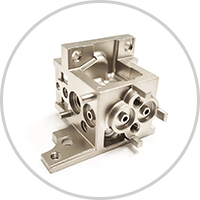
MIM technology also supports parts such as the EPR Flow Block used in Gas Chromatography systems. This component includes multiple through holes and inter-connecting right-angled internal channels.
AMT developed a manufacturing process that manages gas flow across five ports without leakage. This helped the customer mass produce complex geometry parts efficiently and cost-effectively.
AMT received the MPIF Grand Prize in 2018 for this innovation. Read more here.

AMT has perfected the innovative In-Coring process to manufacture metal and ceramic parts with undercut features. This allows designers to create one-piece parts with internal channels and undercuts without assembly.
The process can improve product performance and reduce cost through mass production. One example is a one-piece nozzle used in automotive Selective Catalytic Reduction systems.
This application received the MIM Grand Prize by MPIF in 2015 and the EPMA Award in 2018.

AMT can co-inject two different materials to create an integrated two-material component. This supports combinations such as hard and soft metal or magnetic and non-magnetic metal materials.
By co-injecting materials together, interlocking features can be built into the part. This can remove costly assembly steps and improve product performance.




Accordion Content

MIM can integrate multiple individual pieces into a single complex geometry component. This gives designers more freedom to focus on product function and performance.
Integrated components can reduce part count, improve performance, and lower overall cost. One AMT application using this strategy received the MIM Grand Prize from MPIF in 2000.

AMT can mass produce complex components with very thin walls. For wall thickness below 0.3 mm, our engineers manage distortion, shape retention, material integrity, and dimensional control during sintering.
This capability helped AMT win the MPIF Award of Distinction in 2002.

AMT produced a 105 mm by 105 mm by 1.5 mm fiber optic MIM housing made of Kovar. Kovar is expensive and difficult to machine because of its high nickel and cobalt content.
Using MIM, AMT met specific dimensional and hermetic requirements while reducing material waste. This application received the MPIF Award of Distinction in 2003.
We use cookies to give you the best online experience. By agreeing you accept the use of cookies in accordance with our cookie policy.


